
My earliest memories of Sonic bring me back to playing Sonic the Hedgehog 2 on my family-friend’s Sega Genesis. Much like many gamers I was sucked into the Sonic universe from then on, but it wasn’t until adulthood that I realised how cultural the connection was.
Like many a Black Brit who grew up familiar with the impactful alchemy that is Black American culture, it’s easy to recognise the elements of it in media especially video games, even though it wasn’t my own. In a similar way, the era of Jungle/Drum N’ Bass in video games piqued my ears when hearing the influence of DJs and producers from my own home turf.
When people think of Sonic the Hedgehog, they usually picture blazing speed, bright colours, and arcades. But behind those iconic worlds, characters and sounds lie some deep connections to Black music, style, and cultural influence. From sampled speeches to character design – the culture has always been there, we just had to look.
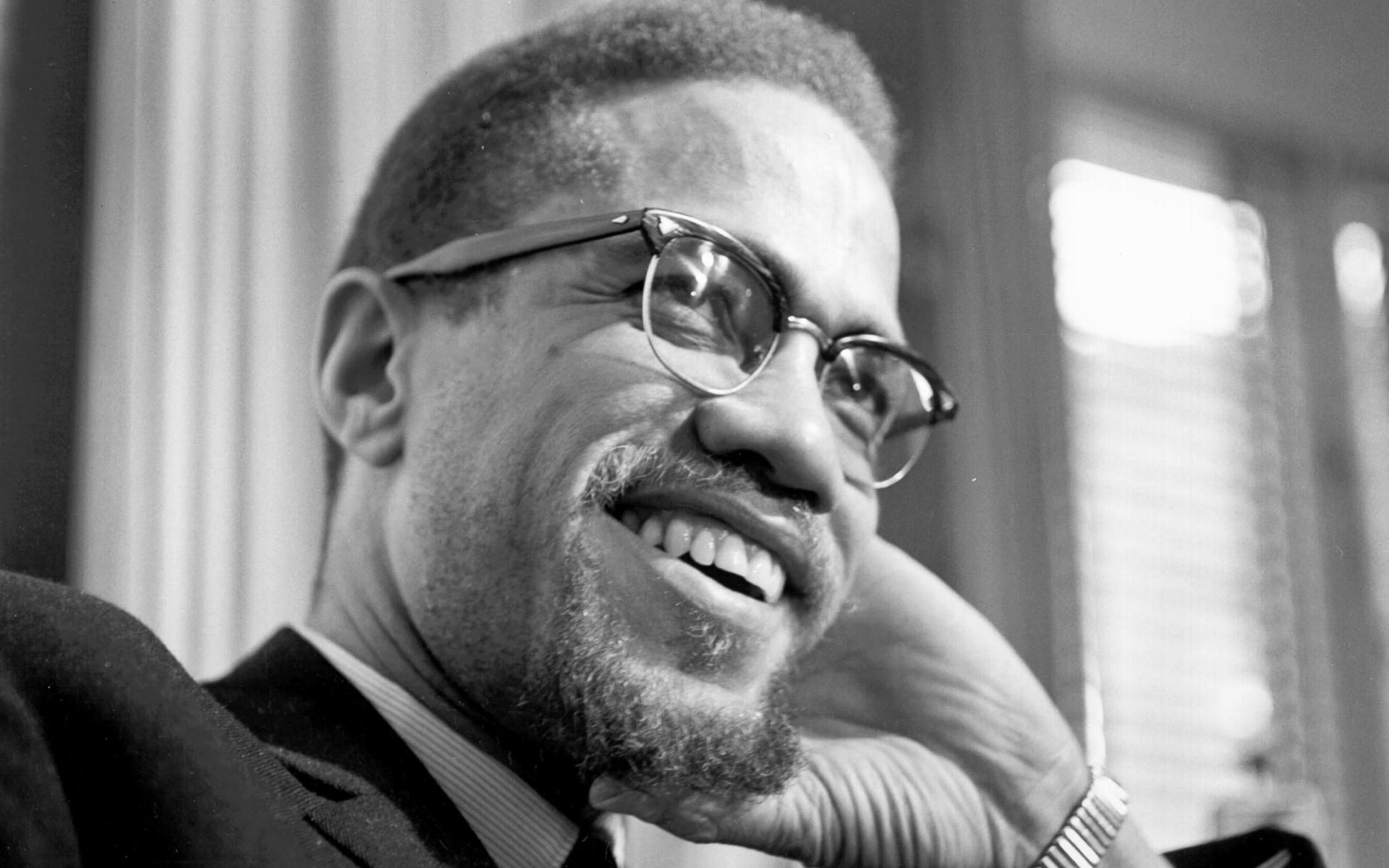
1. “TOO BLACK, TOO STRONG” — MALCOLM X IN SONIC RUSH
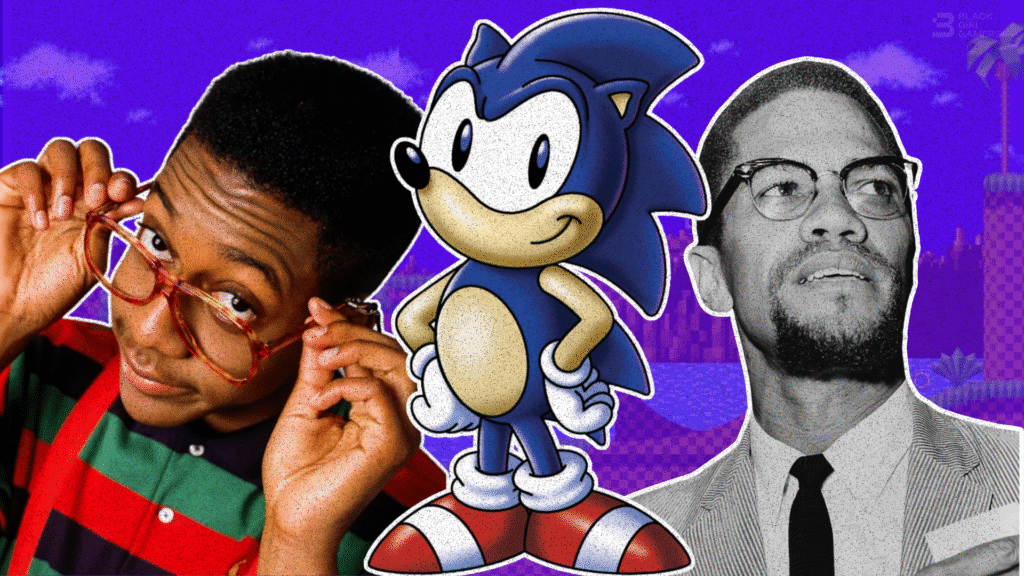
The final boss theme of Sonic Rush, “Wrapped in Black,” does something few expected from a Nintendo DS platformer: it samples the revolutionary Malcolm X. The track loops the phrase “Too Black, too strong” sampled from Malcolm X’s 1963 speech Message to the Grassroots delivered on November 10, 1963, at the Northern Negro Grass Roots Leadership Conference in Detroit, Michigan.
It’s a very bold nod that places Black political expression directly into Sonic’s soundscape, cementing the franchise’s long-standing relationship with Black musical lineage.
2. HIDEKI NAGANUMA: SONIC’S…SONIC ALCHEMIST
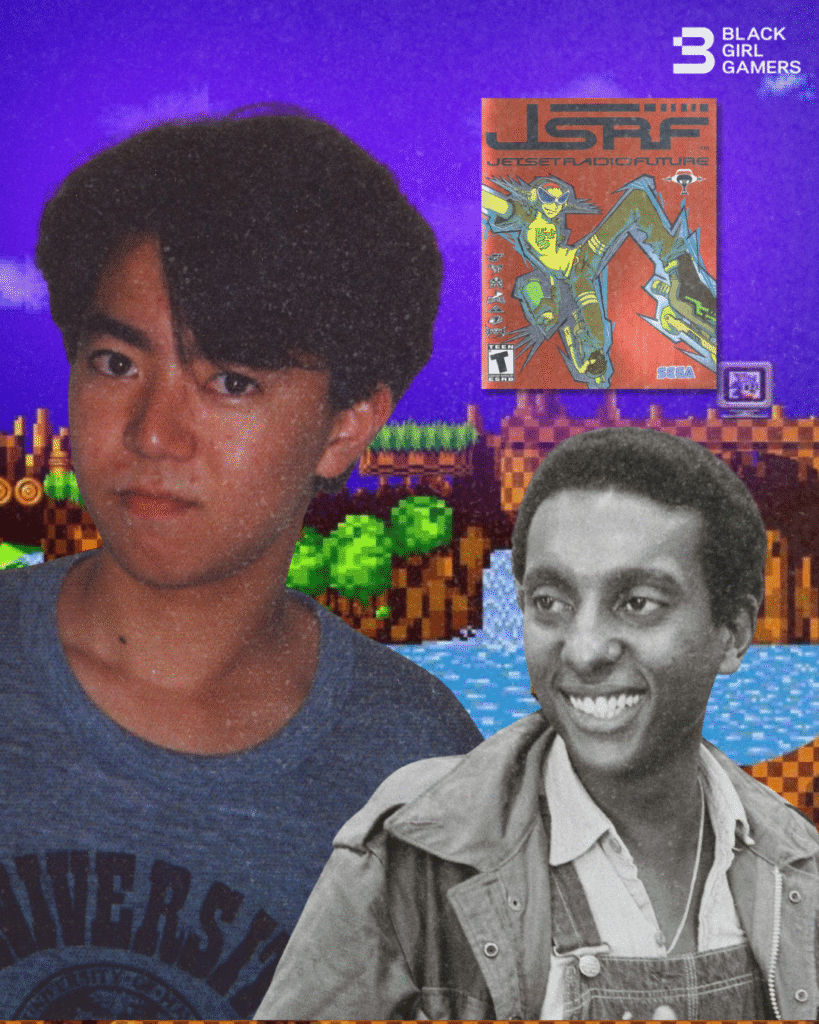
Hideki Naganuma, the legendary composer behind Sonic Rush, is famous for blending Black American genres such as hip-hop, funk, jazz with contemporary rock and electronica into a style that many gamers recognise as quintessentially his.
Though you may be surprised by the Malcolm X sample, it most definitely wasn’t a fluke. Beyond Malcolm X, Naganuma has also sampled Trinidadian-American activist Kwame Ture on “The Concept of Love” for Jet Set Radio Future, pulled from Ture’s 1970 spoken-word album Free Huey.
As a musical virtuoso, Naganuma’s crate-digging sensibilities helped shape a sound that felt modern, incredibly catchy and also rooted in Black history.
3. “COME TO FIND OUT”: SONIC AND THE ECHOES OF ’80S, ’90S & 2000S BLACK MUSIC
Sonic’s music has long been connected to Black music, even outside explicit sampling.
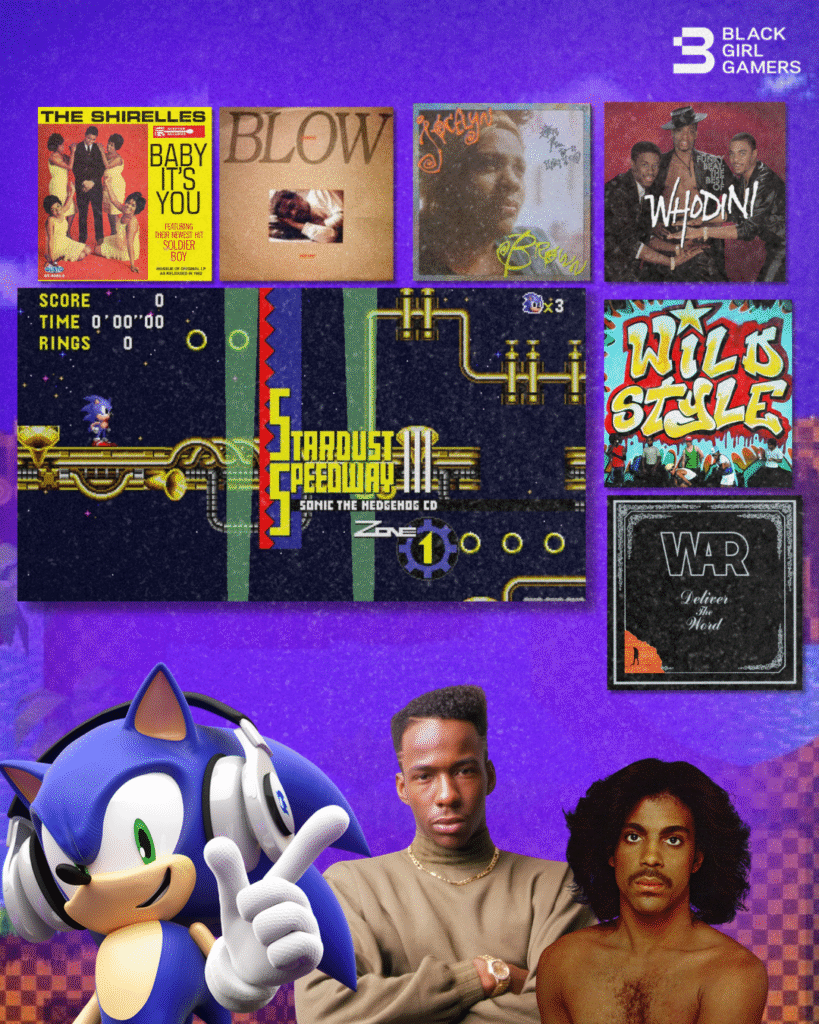
We can hear the undeniable stylistic parallels of Black American genres when playing; like how Spring Yard Zone from Sonic the Hedgehog (1991) sounds uncannily like Bobby Brown’s “Every Little Step.” Or how Chemical Plant Zone from Sonic the Hedgehog 2 has a vibe unmistakenly close to Prince’s “Glam Slam.” And the deeper you dig, the more you find.
Sonic soundtracks across eras echo or sample works from artists such as Jocelyn Brown (“I’ve got the power” from Love’s Gonna Get You appears on Stardust Speedway (Bad Future) on the Sonic CD) but also War, Kool & The Gang, Xavier, Kurtis Blow, Whodini, The Shirelles, Grand Wizzard Theodore and the list goes on.
Fast forward to the games released in the 2000s and you’ll undoubtably hear Jungle/Drum n’ Bass; such as For True Story in Sonic Adventure 2. Jungle and Drum n’ Bass– a predecessor genre and its offshoot– are genres that emerged from the rave scene in the Black British community in the 1990s.
Whether intentional or unconscious, these similarities reflect how much contemporary Black music seeped into the franchise and serve as a reminder that it grew up alongside hip-hop, funk, soul and jungle; and absorbed much of the era’s sound.
4. “URKEL, THAT YOU?” — SONIC’S FIRST ENGLISH VOICE
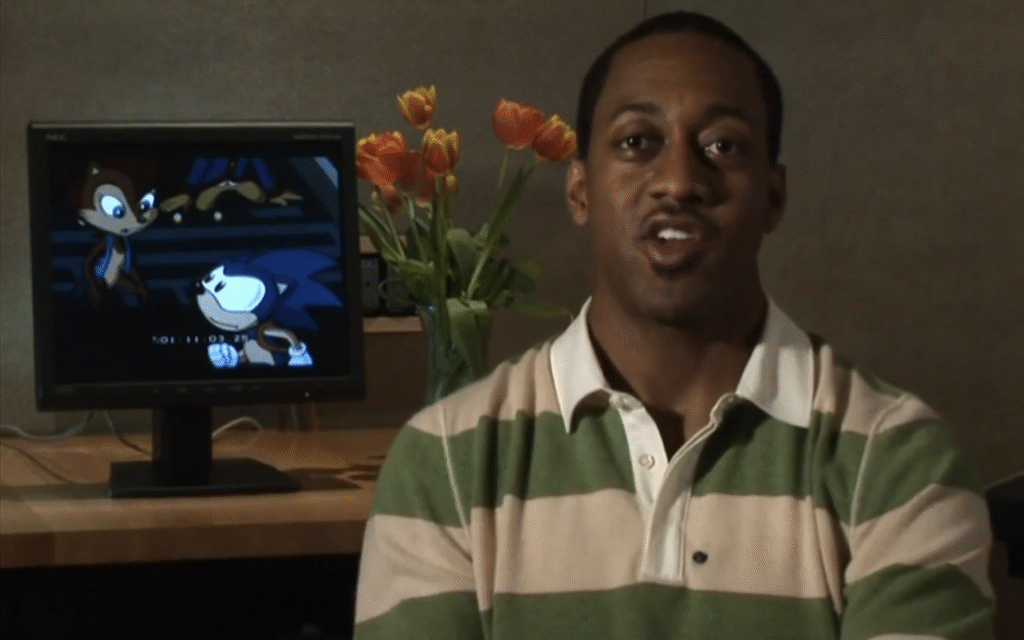
Yep! Sonic’s first official English-language voice actor was Jaleel White, better known as Steve Urkel from Family Matters.
Allegedly, White initially hesitated to take the role for the 1993 Sonic the Hedgehog cartoon. But after encouragement from his mother, Gail, and the show’s producers, he took the role and went on to define Sonic’s early personality. Thank you Ms Gail!
5. SONIC’S SHOES AND MICHAEL JACKSON’S “BAD”
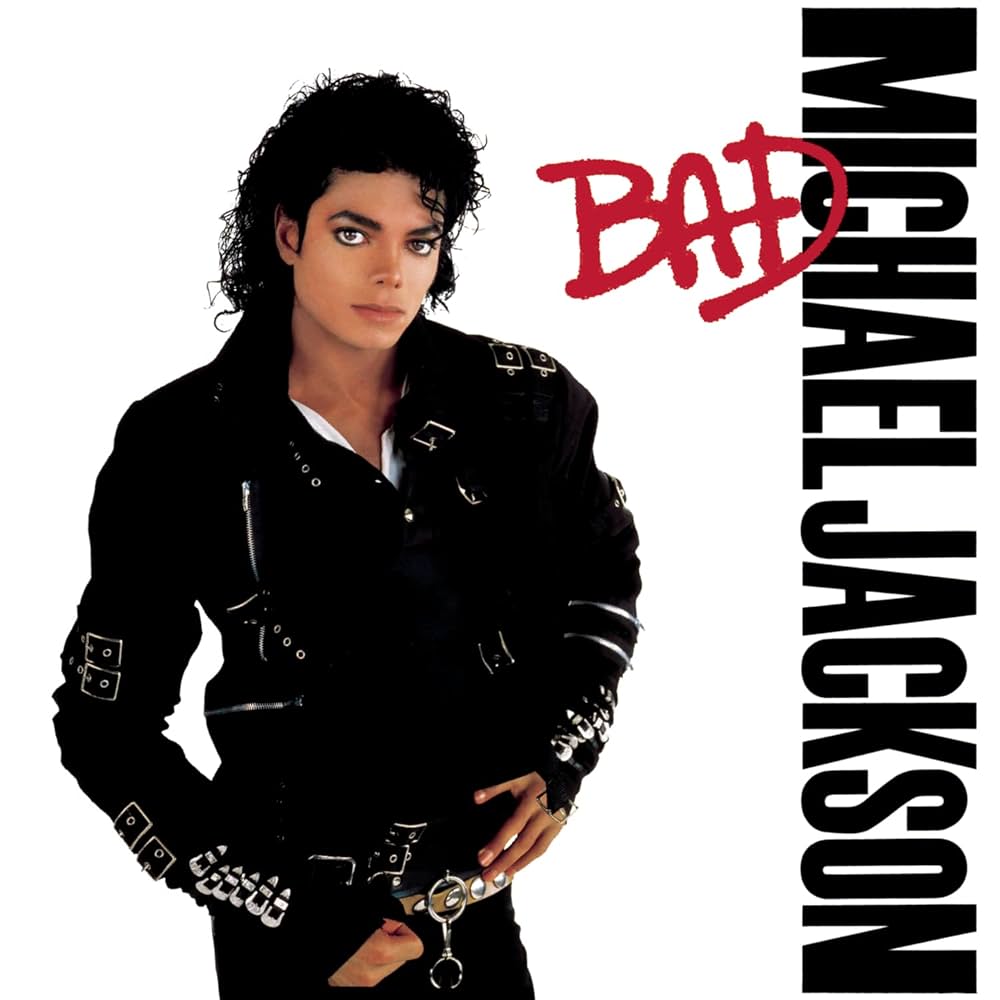
Now this might not be “culture” per se, but it’s worth noting that character designer Naoto Ohshima has said that Sonic’s red-and-white shoes were inspired by the cover art of Michael Jackson’s Bad.
The red stood out dramatically, and Ohshima thought the color would visually emphasize Sonic’s speed (his legs becoming a red blur as he runs).
6. VECTOR THE CROCODILE AND 80S HIP-HOP STYLE
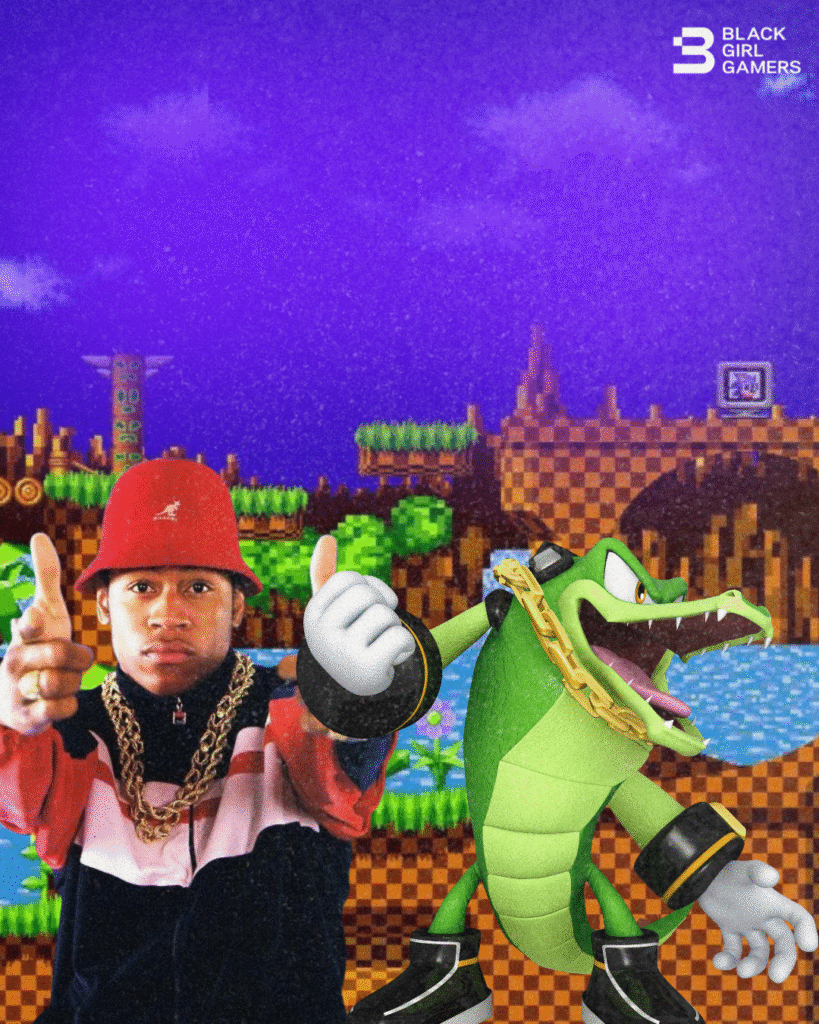
Okay so this one is a little speculative, but tell me that Vector the Crocodile doesn’t draw from 1980s hip-hop aesthetics. Vector the Crocodile first appeared as a playable character in the Sonic universe in Knuckle’s Chaotix in 1995. Allegedly, one of his earliest concept art designs pulled inspiration from The Blues Brothers, but later versions introduced headphones, a bolder shoe game and a chunky gold chain; a staple of 1980s hip-hop fashion from artists like Run-D.M.C. and LL Cool J.
Even if unconfirmed officially, the inspiration feels real hard to miss.
7. LET’S END THE DEBATE: KNUCKLES IS BLACK…OR AT LEAST HE WAS INTENDED TO BE…
Knuckles being perceived as Black was partly an in-house internet joke amongst family. To others not in ‘the know‘, it may seem a little random to see Black folk running round on the internet claiming “Knuckles is Black” but it didn’t just pop out of the ground.
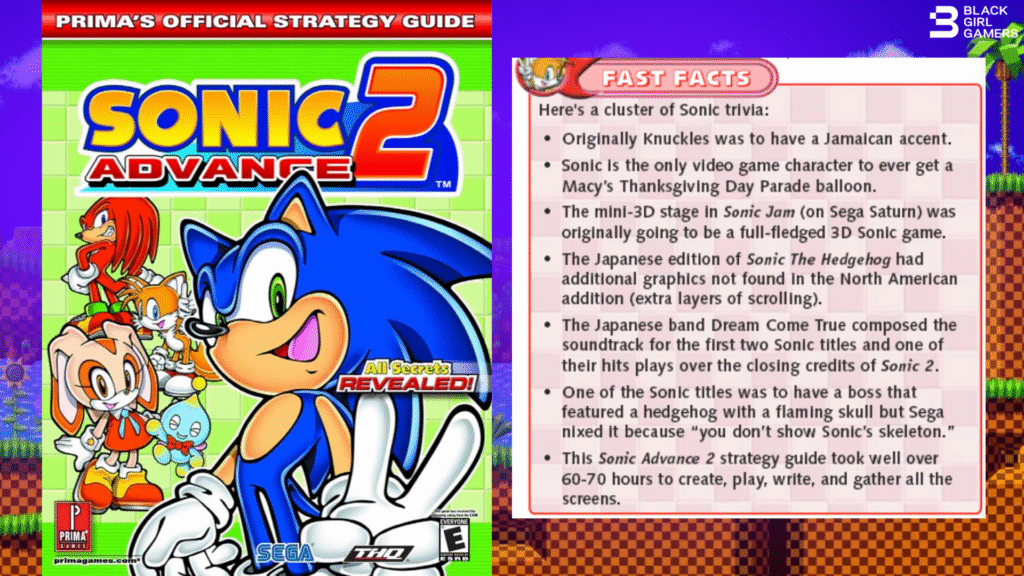
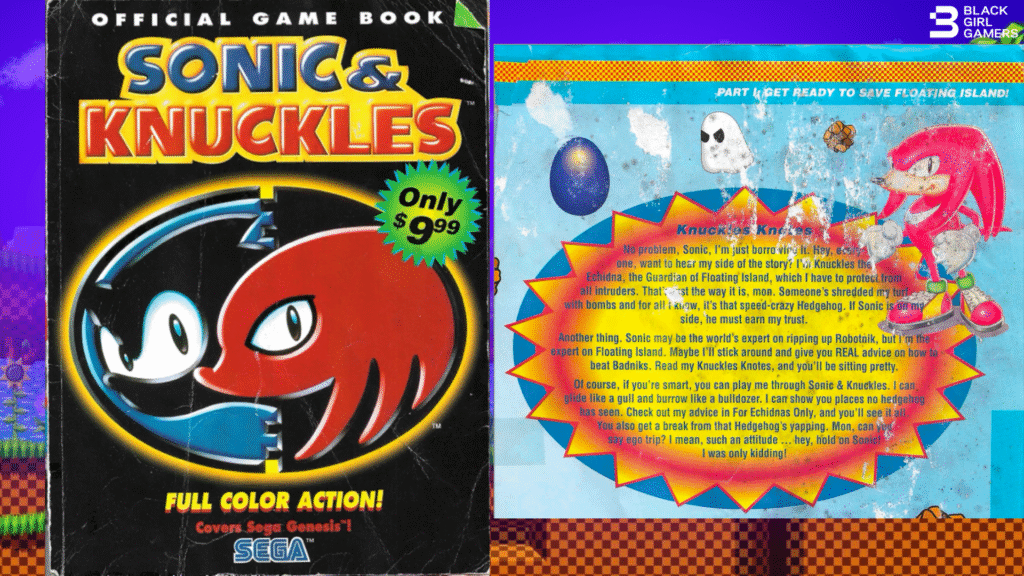
There’s cultural context that lead us here, though this time via ties to Jamaican culture. In Prima’s Official Strategy Guide: Sonic Advance 2, a professional publication that often licensed publisher-approved strategy guides (oh my gosh, remember those?), Knuckles was originally intended to have a Jamaican accent. This fact is further confirmed by the Sonic & Knuckles Official Game Book where you can find “Knuckles Knotes” in which Knuckles speaks in a highly questionable, but no doubt intentional attempt at Jamaican patois, “mon”.
If that wasn’t enough, in Sonic Adventure Knuckle’s theme “Unknown From M.E.”, is a rap track with a boom-bap beat that sharply contrasts with the game’s rock-heavy soundtrack. The musical difference created a cultural shorthand that many of us interpret as aligning him with Black identity.
Though much of the Jamaican connotations are not in-game canon all of the above, combined with Knuckles’ seemingly Rastafarian-flag-inspired shoes, lean towards him being Jamaican-coded in his early days at the very least.
THE DIGITAL IMPACT OF BLACK CULTURE
From sampled speeches and musical parallels to representation in voice acting and design, Black culture has left a real, lasting imprint on the Sonic franchise. It’s part of what connected us to the franchise throughout its 34 years of existence. Sonic may be blue, but him and his universe always had a whole lot of of Black cultural influence running through him.