
Since the inception of video games, Black gamers have been demanding more representation in the titles we love. Many of us grew up exploring ancient civilizations with Lara Croft and battling literal gods with Kratos—laughing, crying, and overcoming impossible odds alongside them. We connected with their histories and storylines, even when we didn’t see ourselves reflected in their worlds.
Nearly 70 years later, conversations around representation are louder than ever. Yet titles centered on Black stories and Black protagonists still face skepticism, harsher criticism, and quieter support than their counterparts. Sure, larger studios may occasionally invest in inclusion, but those projects don’t always receive the same visibility or marketing push.
Supporting games created across the Black diaspora isn’t only about seeing ourselves in a medium we love; it’s about recognizing the unsung people who are helping shape the tech and gaming industry—making sure more of our voices get the chance to create, be discovered, and shine in the spotlight.
Black developers, known and unknown, have influenced some of our favorite adventures, from childhood to the present day, even when their contributions weren’t always front and center. Trailblazers like computer engineer Gerald “Jerry” Lawson (known as “the father of the video game cartridge”) and early microprocessor specialist Ed Smith (co-designer of APF’s Imagination Machine, one of the first video game consoles released in the late ‘70s) helped expand what games could become, creating space for Black industry leaders and studios continuing that legacy today.
Games like Nyamakop’s Relooted and Surgent Studios’ Tales of Kenzera: Zau challenge unique perspectives on loss while reclaiming historical narratives. In their own ways, each game transforms grief into a powerful story about healing and legacy. Whether it’s exploring mental health or taking back pieces of our history, these games aren’t niche. They’re imaginative, emotionally raw, genre-defining experiences that deserve to be played and celebrated. Titles like these offer cultural reflections, and jump-start important conversations that are often overlooked in our communities and mainstream media more widely, exposing audiences to narratives they may have never discovered otherwise.
Every demo download, wishlist add, purchase, stream, and conversation sends a message: These stories matter, our stories matter, and the future of gaming is stronger when more of us get to build it.
Here are a few other Black developers who are shaping the industry with us in mind.
After spending nearly a decade trying to break into the industry, Neil Jones decided to and build a game of his own. Under the moniker Aerial_Knight, the Detroit-based developer released his debut title Never Yield in 2021, followed by its 2024 sequel, We Never Yield.
Available on PC, PlayStation, and XBOX, both games are cinematic, side-scrolling action runners fueled by a strong pulse-pounding, jazz and hip-hop soundtrack. Set in an afro-futuristic version of Detroit, players first take on the role of Wally, a teenager who uncovers a powerful secret. Not letting his prosthetic leg hold him back, Wally must outrun those determined to keep the truth hidden, physically and mentally.
In the sequel, players meet Wally’s twin brother, Lone, and their evil Aunt, Queen Karmic. With the help of a time jump, our heroes are thrown into a world that Neil calls “afro-medieval,” yet its somehow still reminiscent of the alleyways of Detroit. With inspiration taken from the 2001 film Black Knight, starring Martin Lawrence, it’s easy to see why so many players praise this series for its ability to blend aesthetic and style with all the charm of Motor City.
Never Yield, and We Never Yield’s two-hour runtimes make both titles approachable for an afternoon playthrough, maybe even back-to-back if you’re feeling adventurous, alongside endless and competitive modes for additional ways to chase mastery.
In February, Aerial_Knight doubled down on the studio’s signature style and returned with Dropshot, a fast-paced arcade shooter where players free-fall from the sky, battle enemies mid-descent, and race to claim a parachute while “armed with limited Finger Gun bullets.” Never short of compelling characters, the title introduced players to Smoke Wallace—a man transformed after being bitten by a radioactive dragon and out for revenge for his family. Like its studio predecessors, Dropshot has been received positively on major platforms, with Polygon calling it a “playable Mission: Impossible stunt” and The Verge saying the title “captures the thrill of skydiving—might be better than the real thing.”
Jones is hyper-aware of his impact on the industry, acknowledging that his name is one of the few that pop up in searches for Black game developers. “If you want more games with different types of characters and characters that look like you, then go support those games,” he said in an interview with Epic Games. “You gotta go buy the games so that publishers and big platforms have to take notice.”
Virago: Twisted Reality from Honest Chronicle
Founded by Sunday Akor, Honest Chronicle is the first Nigerian-based game studio to surpass one million downloads across its catalog of mobile games—a milestone that reflects both global curiosity and the growing demand for indie games in the mobile space.
The Virago series, also available on Steam, follows Willow, a troubled young girl whose grip on reality becomes increasingly unstable as she tries to escape a relentless stalker and put the pieces of her life back together.
Each game—Herstory (2022), Trepidation (2023), Reality New (2023), and Virago World (2025)—is designed as a top-down, 2-D adventure with open-world exploration and tense pursuit sequences. Carefully blending suspense with psychological storytelling, each chapter explores trauma, survival, and resilience through the lens of puzzle-solving gameplay.
Though he’s been an avid gamer since about 15, Akor made major waves in Nigeria when debuting Virago as a self-taught developer at just 18 years old. When speaking with local news outlet Channels Television in 2022, he explained that after getting comfortable with the tools and programs needed to build, it took him only roughly two years to complete his first prototype.
Notably, he has spoken openly about the major themes of the game being inspired by the hardships women and femme-presenting folx face when dealing with everyday society. And since the release of the original title, the series has only continued to grow in popularity worldwide as its messages continue to hit closer home, especially for Black women everywhere.
In 2026 alone, there has been a reported uptick in Black women being murdered across the United States, with many advocates declaring a Black femicide sweeping the nation. As history has taught us, even up to a researched report published in October 2025, Black women are being disproportionately targeted and killed—and it’s not being talked about enough. That lack of urgency makes powerful projects and voices like Akor’s stand tall in an industry known to ignore the call for safety and allyship from a major part of its consumer base.
“I always been someone who likes to speak up on injustices that happen,” he told Channels, “so I decided to use my skill for game development to make an indie game where I can speak up about people being oppressed, or people who don’t have a voice; to be a voice.”
And his mission is just beginning, as two more titles—Herstory 2 and Twisted Reality—are currently in development and additional tales available on Google Play and iOS.
Aurion: Legacy of the Kori-Odan from Kiro’o Games
Founded in 2012 by Cameroonian programmer and entrepreneur Guillaume Olivier Madiba, Kiro’o Games, the first video game studio developed in Central Africa, was built with the bold mission of creating a new kind of gaming experience inspired by African mythology and storytelling. The studio’s name, which comes from the Swahili phrase kiroho maono, meaning “spiritual vision,” is a fitting foundation for the history-making studio determined to create worlds players hadn’t seen represented in their gameplay, or even imagined, before.
Available on Steam and Xbox, Aurion: Legacy of the Kori-Odan, released in 2016, is a single-player 2-D action RPG that draws inspiration from classic JRPGs, while staying rooted in its Cameroonian influence.
Players follow Enzo, the newly crowned King of Zama, and his wife, Erine, whose wedding day is shattered when their kingdom is attacked, and they are forced into exile. Their journey to reclaim their home quickly becomes something bigger than revenge. Along the way, they confront political realities, challenge long-held beliefs, and discover that leadership isn’t inherited—it’s earned.
Outside of being well received amongst gamers and developers, and being one the few African-themed RPG titles on the market, Madiba remains in a lane of his own after making history in 2024 as the first Black African game developer to launch a title on Xbox.
Following the success of his $1.7 million equity crowdfunding campaign through the studio’s Rebuntu platform in 2022, Madiba has since been doing his part for the next generation, focused on mentoring the developers of tomorrow. With the vision of seeing “at least 400 million players” on the continent playing African-inspired games by 2030, he’s working with an in-house team and formerly full-time employees turned freelancers to make it happen.
“Ten years ago it was very hard to recruit but today, there are more talents in the freelance/outsourcing pool thanks to the content creator ecosystem,” said Madiba of the local scene. “You find more young people doing animation and even coding ambitious projects on their own that you can canalize.”
Gravity’s Edge from Kassle Games
Kamau Vassell has been playing video games since he was a child and making them since he was a teenager. And for over 15 years, he has cemented his space in the industry, working on AAA titles such as Madden and other EA titles, before stepping out on his own. Since founding Kassle Games in 2025, Vassell has stated that he wanted to create something that spoke to his love of science and his Caribbean heritage, and the result was Gravity’s Edge.
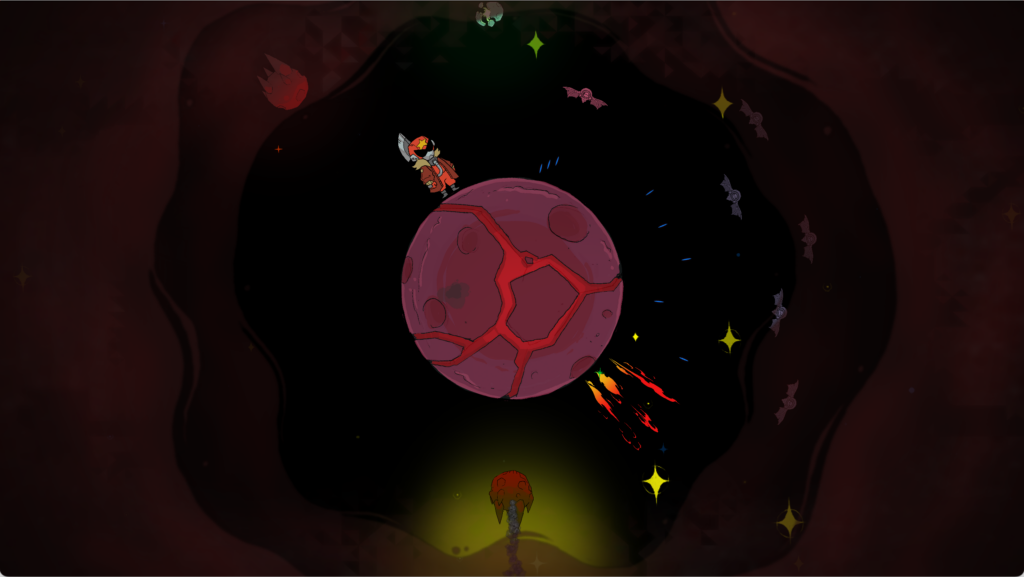
Released back in May on Steam, Gravity’s Edge weaves elements of Ghanaian and Akan lore into a historical timeline where the diaspora reaches space with “Big Jamaican flair.”
The 2-D, puzzle-solving action-adventure follows a young protagonist traveling across a series of planets in search of his missing father, with each new world presenting its own environmental challenges. Through physics-inspired gameplay, the story slowly reveals itself across each planet explored, as players “uncover mysteries, fight aliens, visit cities to do quests, all while being bound by gravity to the small worlds that you walk on.”
For Vassell, Gravity’s Edge is more than just a game; it’s a chance to put his own stamp on the sci-fi gaming genre. As he explained in a recent interview, “I would love everyone to know that I made this game to bring something new to the world that has never been seen before. This game admires physics, space, puzzles, exploration, and culture!”
Though aiming to create something new, Vassell did what the best artists do: use what he knows best to connect to a wider audience. “I am of Caribbean descent. So basically, I’m just making what I know,” he said of his inspirations. “I didn’t think too much about it. The same goes for the Akan symbology.”
Circuit Chakula from Mykiyi Entertainment
What happens when you make the comforting rhythms of a late-night café game the soundtrack of a bustling, futuristic African city? You get Circuit Chakula, a “cozy afro-futuristic visual novel” from Nigerian studio Mykiyi Entertainment.
Co-founded by game developer and narrative designer Oluwaseyi Ogunrinde, the remote-first studio has made its mission clear from the start: “We explore various cultures and societies to showcase uniquely rich stories for a global audience,” the team writes on its itch.io page, where a free Windows version of the game launched in May 2025 on a name-your-own-price model.
Set in a vibrant metropolis where tradition and advanced technology coexist, players step into the role of a night repairman working inside Kubwa Kulu, the tallest commercial building in the city. Your job is simple: listen to your customers and fix what’s broken. But in a world stunned by the sudden arrival of aliens on Earth, your customers aren’t always human. Across your shift, you’ll meet humans, humanoids, holograms, and extraterrestrials, each carrying their own stories, struggles, and perspectives. Through calming repair puzzles and branching choices, the relationships you build ripple outward, affecting individual lives, and maybe the world itself.
And the industry is taking notice. IsaKaba spotlighted Circuit Chakula among the most promising African-made titles at Gamathon 25, and the studio went on to become one of three finalists at the Lagos Games Week 2026 Pitch Stage, with PocketGamer noting the title on the show floor as one of the standout works-in-progress from the region.
Drawing inspiration from beloved barista sims Coffee Talk and VA-11 Hall-A, Mykiyi is intentional about what it’s building. “Interpersonal relationships play a significant role in African communities,” the studio explains, “and amidst vast economic disparities, we aim to showcase the beauty, and tranquillity in the connection of everyday people.”
Even with aliens entering the equation, Circuit Chakula is most interested in asking a very human question: how do we continue to care for each other when the world changes—quickly and drastically—around us?
TossDown from Fer Factor
Most delivery jobs come with deadlines, but this one ups the ante to pulse-pounding levels.
TossDown is the debut title from Lagos-based indie studio Fer Factor, self-described on its Steam page as a blend between Sega’s Crazy Taxi and Jet Set Radio. The upcoming PC release transforms everyday urban movement into a fast, stylish arcade experience built around momentum, experimentation, and pure chaos.
Founded by developer Feranmi Oladosu, the studio blends roguelite action and classic arcade runner design into short, replayable runs. Players race through obstacle-filled environments delivering packages while chaining movement, dodging hazards, and making the most of absurd power-ups. The design rewards speed and improvisation, encouraging players to keep refining their skills run after run.
Rather than treating city life as background scenery, TossDown draws inspiration from the unpredictability and rhythm of navigating urban spaces—reframing the energy of everyday survival through playful mechanics and expressive movement.
Though the title isn’t out yet—it’s slated for 2026, with a free demo available on itch.io—the game has already found a powerful believer. In 2025, newly relaunched publisher Acclaim announced it would publish TossDown and feature the game at Gamathon Nigeria, where thousands of attendees got to play it IRL. Games Industry Africa described the title as “a fast-paced love letter to the Dreamcast era”—fittingly, given its arcade DNA.
For Oladosu, TossDown is one piece of a bigger vision for the Nigerian games scene. As he told PocketGamer, more finished games mean “more jobs, mentorship and the cycle continues.”
Riziki from Weza Interactive Entertainment
Some stories are told with words. Riziki tells its story through movement.
Created by Kenya-based studio Weza Interactive Entertainment, Riziki is a rhythm game built around one of Africa’s most universal forms of connection: music. Players follow the ancient spirit Riziki as it guides Nabo and Moja on a journey across the continent, using rhythm and movement to reunite a divided world.
Across each region players visit, new songs, dance styles, and avatar customizations unlock, with a soundtrack spanning Afrobeats, Amapiano, genge-tone, dancehall, and beyond—from traditional folk instruments to modern club anthems. The studio is also building seasonal collaborations with established and emerging African artists, alongside leaderboards for players chasing the title of Ultimate Rhythm Champion. As Weza puts it on the game’s itch.io page: “Riziki isn’t just a game. It’s a movement.”
Founded in 2017 by CEO Odongo George Ahere, the Nairobi-based studio has spent nearly a decade building the Mzito Universe, an interconnected world of games centered on ancient African spirits and the cultural pillars they represent, spanning the 2-D platformer Mzito and the educational title Mzito Math. Riziki continues that mission, and in 2021 was among the first recipients of the African Game Developer Prototype Fund.
For Ahere, the design philosophy is simple. As he told PocketGamer, the studio aims to “merge games with Africa’s finest tunes and rhythms”—and to meet African players where they are, which is why the title launched mobile-first.
The studio also describes its long-term goal as building one of the largest collections of African and African-inspired music ever featured in a game, transforming play into musical discovery. And there’s something magical about a game that wants you to feel the music instead of just hearing it.
Riziki is available now on Google Play, and with iOS early access underway and console and PC versions planned for 2027 (PC and Xbox) and 2028 (PlayStation and Nintendo Switch), players have another reason to add it to your wishlist before the rest of the world catches the beat.