
Read time: 5 minutes
I walked into that room full of SEGA developers with no real frame of reference. I’m familiar with the Yakuza titles and Like a Dragon, but I’d never actually played any of them. Despite my curiosity, I went in knowing very little about what Stranger Than Heaven would be or what to expect. What I walked out with was a genuine appreciation for a combat system I’d grossly underestimated. I knew I was experiencing something special because months after playing it, it’s still heavy on my mind.
Stranger Than Heaven is an action-adventure game from RGG Studio and SEGA, a distant prequel to the Like a Dragon franchise. It follows Makoto Daito, a Japanese American outcast who carves out a new life in Japan across a story that spans 50 years. The saga opens with a young Makoto sneaking aboard a mysterious ship in the dead of night, then unfolds across five eras and five cities, each modeled on a real location from its time period: 1915 Kokura in Fukuoka, 1929 Kure in Hiroshima, 1943 Minami in Osaka, 1951 Atami in Shizuoka, and 1965 Shinjuku in Tokyo.
As Makoto’s story progresses, the drinking, gambling, and other risqué pastimes eventually give way to his love for music and a path into show business as a producer and performer.
But the hands-on demonstration during Summer Game Fest wasn’t about any of that. Before the demo stations opened, SEGA’s team ran us through a short presentation and trailer to set the stage, and it quickly became clear we weren’t there for Makoto’s showbiz arc or a deep dive into the eras. We were there for one thing: the combat, and specifically how you fight.
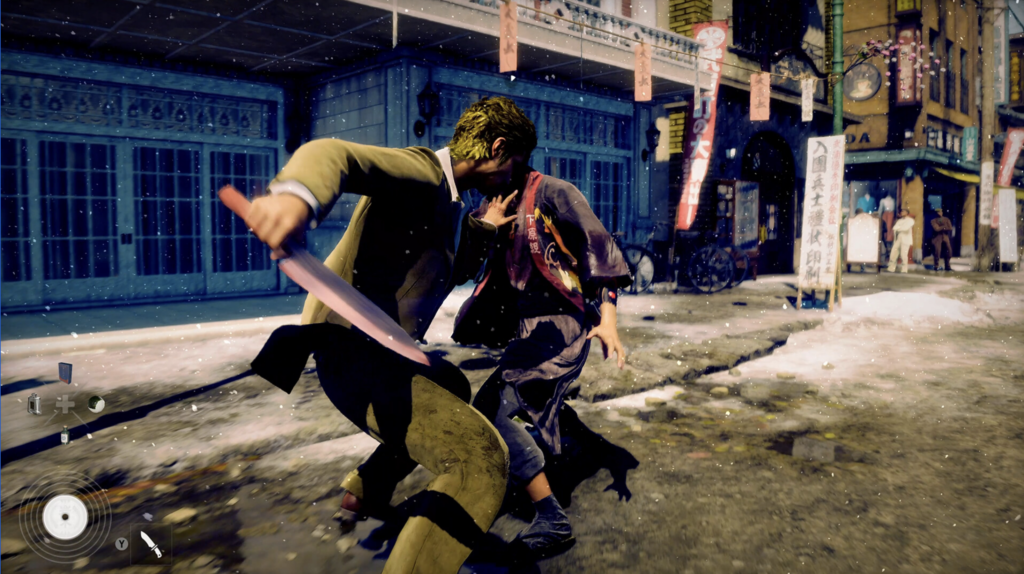
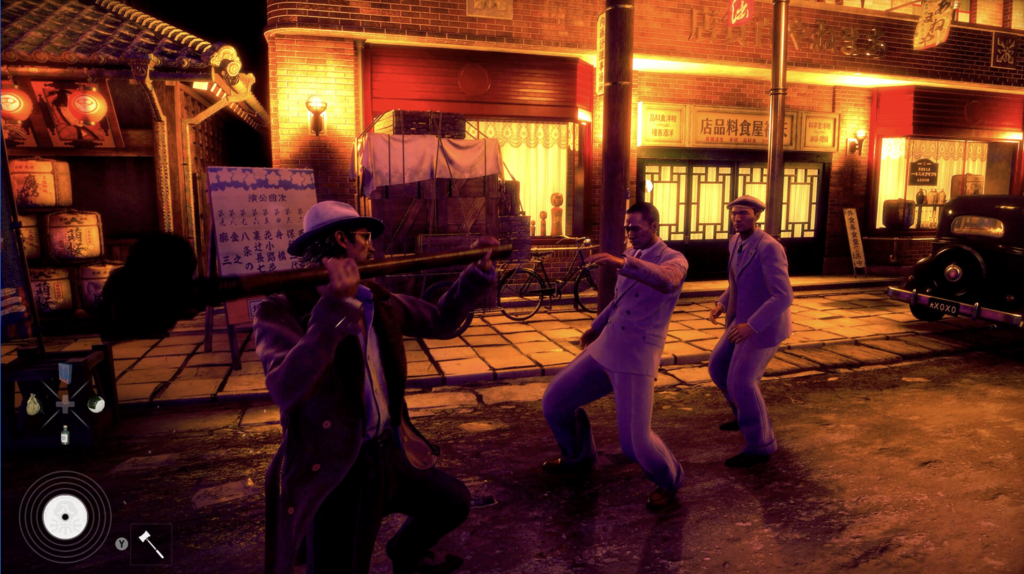
Instead of mapping attacks and combos to face buttons, like most fighting games, the developers split your character’s body down the middle. The right bumper and right trigger control Makoto’s right side; the left bumper and trigger control his left. Every punch, kick, guard, and counter comes from treating those two halves independently—closer to how people actually move in a fight than to memorizing a fixed combo string.
Layered on top of that is a full weapon system. The finished game will ship with 13 weapon types, three of which I’ve tested myself. There are also charge attacks for heavier hits, directional dodging, item-based healing (rice balls, naturally), and a guard-and-counter system tied to timing rather than button mashing.
On paper, it sounded almost too simple. Two bumpers, two triggers—that’s it. Coming from fighting games where I’d memorize string combos to chain hits together, four inputs read as basic. Then I actually played, and everything I thought I knew went out the window.
I played through three combat encounters across three time periods, escalating in difficulty. The year 1915 was the entry point: a beginner-friendly fight designed to get players comfortable with the basic left/right attacks before anything more demanding arrived. Then, 1929 moved into intermediate territory, with a larger, slower-moving boss that punished carelessness and any failure to use my guard to its fullest. And finally, 1943: the wall. A faster, more aggressive boss who gave me nowhere to run and hide if I hadn’t absorbed the lessons of the first two.
I went in expecting to breeze through 1915 to get to the hard stuff, and immediately caught myself falling back into my old habits of mashing instead of working the triggers and bumpers. By 1929, I had to lock in (because I was getting cooked). The fight pits you against a bigger boss and a crowd of smaller lackeys who don’t politely take turns; some come at you two or three at once. I had to get strategic with my dodges and parries while constantly repositioning the camera to track the boss, who charges up at a distance before committing to an attack. I replayed it a few times before it finally went down.
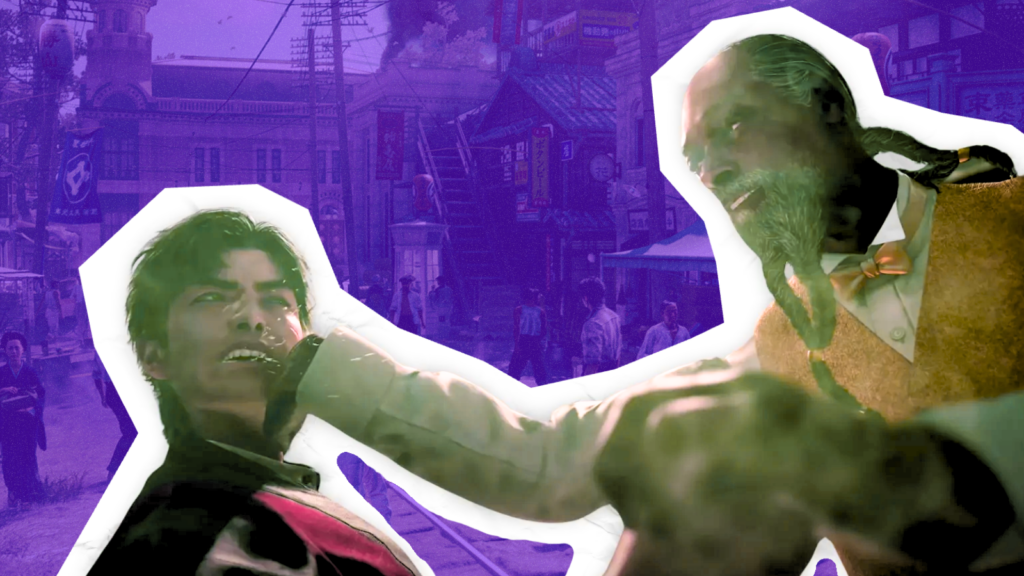
Then came 1943, the stretch that made me remember why I love the SEGA team. Those first two fights were child’s play next to the samurai waiting on a stone bridge, outlined by townspeople scattering and screaming as we squared off. A couple of people who’d already finished the demo warned me on their way out, “Parry will be your best friend.” Every single person in my session struggled with the samurai. Each death taught me a little more about my own tendencies and his attack patterns; I’d get close to killing him, he’d switch styles, and I’d go down.
It got demoralizing. I was well past my 30-minute slot, but I was the last person left, so the entire Stranger Than Heaven team rallied behind me, calling out specific tells and when to parry or guard. Yes, I needed the cheering section, and they showed up.
It came down to the final two attempts. My heart was pounding; I leaned into the screen, and I locked onto everything the team was feeding me—one with the controller, like it was my own body in the fight. I could hear them yelling to hit him while he was healing, clapping at every clean parry and roll. Then the finish, which I’ll admit I half-fumbled into: the boss charged, I didn’t parry in time because I hit the wrong button, backpedaled by accident, and ended up behind him and landed the final blow. The moment his body hit the ground, the team gave me a standing ovation.
That’s the whole reason I love games. I had no choice but to respect the depth underneath those four inputs, and to let go of everything I thought I knew about fighting.
The experience did exactly what a good demo should: it made me want more. I still haven’t touched the Yakuza games, but this feels like a doorway into finally understanding what those titles are about and how this prequel connects to them. The combat alone sold me. I’m already looking forward to playing it again.
Stranger Than Heaven is set to release on January 15, 2027, on PlayStation 5, Xbox Series X/S, and PC (Steam), with day-one availability on Xbox Game Pass.